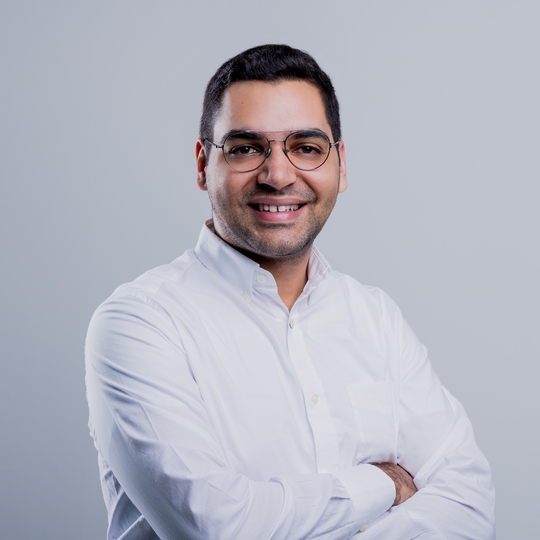
Anas Barakat
Research Fellow
Singapore University of Technology and Design
I am currently a Research Fellow at Singapore University of Technology and Design, working with Georgios Piliouras and Antonios Varvitsiotis. Previously, I was a postdoctoral fellow at ETH Zurich working with Niao He. I received my PhD in Applied Mathematics and Computer Science from Institut Polytechnique de Paris (Télécom Paris), advised by Pascal Bianchi and Walid Hachem.
Research
Policy Optimization and Multi-Agent Learning
My research lies at the intersection of optimization, reinforcement learning, and game theory. I develop foundations and algorithms for policy optimization in strategic and dynamic environments. My current interests include policy optimization for reliable LLM post-training and learning and incentive design in agentic markets.
Selected Publications & Recent Research
For a complete list of my publications, see below or my Google Scholar.
News
Experience and Background
Here is my CV for more information.
Research
Publications
Policy Optimization and Reliable Post-Training
I study policy optimization when objectives extend beyond standard expected additive rewards. My work designs and analyzes policy gradient methods for general utility reinforcement learning and related nonlinear objectives, with global optimality guarantees. More recently, I have studied objective design and policy optimization for LLM post-training, where related nonlinear objectives arise in practice. Going forward, I am interested in foundations and algorithms for reliable reasoning, including sequential calibration and the use of calibrated uncertainty to guide inference.
Multi-Agent Learning in Strategic and Dynamic Environments
I study the learning dynamics of multiple adaptive agents interacting in strategic and evolving environments under limited feedback. My work develops foundations and algorithms for learning in static, Markov, and dynamical games, with guarantees for convergence, equilibrium learning, and regret in settings that include adversarial disturbances and limited or preference feedback. Going forward, I am interested in coupled learning and incentive design for interacting AI agents acting on behalf of different principals in agentic markets.
Broader Foundations in Optimization and Learning
I also study online learning and stochastic optimization. In particular, my recent work studies online learning with hidden-convex losses, including under bandit feedback. This perspective connects to my work on general utility reinforcement learning and Markov games, where apparently nonconvex policy-space objectives inherit favorable structure from their underlying occupancy-measure representations.
My earlier PhD work studied adaptive gradient methods for nonconvex stochastic optimization through dynamical systems and stochastic approximation perspectives.
Student Mentoring
-
Olivier Lepel — Master’s thesis, Mar.–Sep. 2024
Policy Gradients for Cumulative Prospect Theory in Reinforcement Learning. TMLR 2026.
Currently: Data Scientist at BCG. -
Kimon Protopapas — Master’s semester project, Sep. 2023–Jan. 2024
Policy Mirror Descent with Lookahead. NeurIPS 2024.
Currently: Research Intern at University of Basel. -
Philip Jordan — Master’s thesis, May–Dec. 2023
Independent Learning in Constrained Markov Potential Games. AISTATS 2024.
Currently: PhD student at EPFL. -
Jiduan Wu — Master’s thesis, Oct. 2022–Mar. 2023
Learning Zero-Sum Linear Quadratic Games with Improved Sample Complexity and Last-Iterate Convergence. IEEE Conference on Decision and Control (CDC) 2023, SIAM Journal on Control and Optimization, 2025.
Currently: PhD student at Max Planck ETH Center for Learning Systems. -
Harish Rajagopal — Master’s thesis, Mar.–Sep. 2022
Multistage Step Size Scheduling for Minimax Problems.
Currently: Quantitative Technologist at Qube Research & Technologies. -
Julien Lehmann — Master’s thesis, May–Oct. 2021
Analysis of a Target-Based Actor-Critic Algorithm with Linear Function Approximation. AISTATS 2022.
Currently: Research Engineer at OCamlPro.
Teaching
SUTD (2024-2025):
- Co-created and co-taught a new graduate course from scratch, Topics in Games, Learning and Optimization together with John Lazarsfeld and Iosif Sakos. We developed the syllabus, course content, and lecture notes.
ETH Zurich (2022-2024):
- Teaching Assistant and instructor for 2 lectures for the course Optimization for Data Science (Prof. Niao He).
- Head Teaching Assistant and instructor for 1 lecture (on value-based methods) for Foundations of Reinforcement Learning (Prof. Niao He).
- Coordinator of the seminar course ‘Advanced Topics in Machine Learning’.
Télécom Paris (2018-2021): Teaching Assistant
Optimization for Machine Learning (graduate level), Statistics (graduate level), Probabilities (undergraduate level).
Academic Service
- Area Chair: ICLR 2027, ICML 2027.
- Conference Reviewing: NeurIPS (‘22, ‘23, ‘25, Top Reviewer ‘26), ICML (‘25, Gold Reviewer ‘26), ICLR (‘25, ‘26), AISTATS (Top Reviewer ‘22, ‘24, ‘25, ‘26), EC (‘26).
- Journal Reviewing: Journal of Machine Learning Research (JMLR), Transactions on Machine Learning Research (TMLR), Mathematics of Operations Research (MOR), Mathematical Programming, SIAM Journal on Optimization (SIOPT), Journal of Optimization Theory and Applications (JOTA), IEEE Transactions on Automatic Control.